2027 Audi Q9 And SQ9 Revealed: Audi’s First Full-Size SUV Arrives With Three Rows And Up To 591 HP
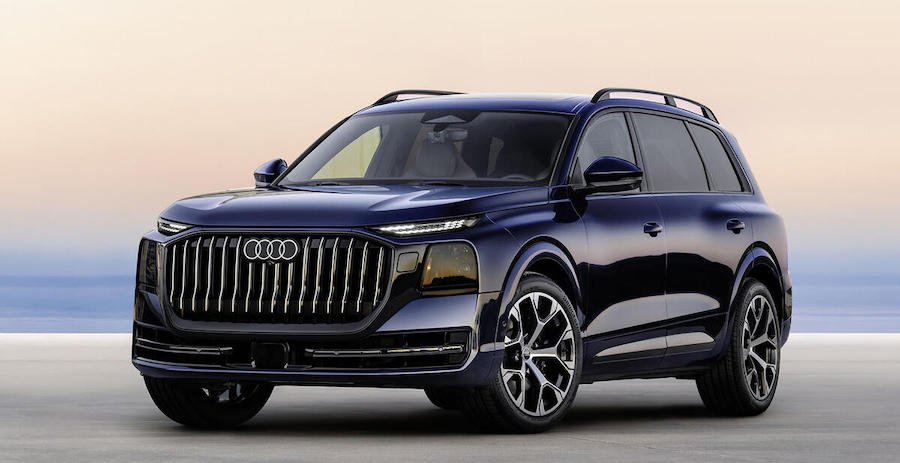
Audi has built plenty of SUVs. Small ones, midsize ones, electric ones, fast ones, coupe-ish ones, and even bigger ones, like the Q7. But until now, Audi has never had a true full-size, three-row SUV sitting at the top of its lineup to effectively rival the BMW X7 and Mercedes-Benz GLS-Class. That all changes with the 2027 Audi Q9.
The new Q9 is Audi’s largest SUV to date, its first model to wear the number 9 since the early ’90s, and the brand’s clearest attempt yet to take on the full-size luxury SUV market with something designed specifically around North American expectations. Think real three-row space, adult-friendly second-row comfort, serious towing capacity, high-output gas engines, a tech-heavy cabin, and theatric lighting systems.
Audi isn’t being subtle about what this vehicle represents. CEO Gernot Döllner calls the Q9 “the new flagship of our portfolio,” and the company says the model is meant to elevate Audi’s premium positioning with more space, comfort, and technology than any Audi SUV before it. The Q9 will arrive at U.S. dealers later this year, while the performance-focused SQ9 launches in the fourth quarter of 2026. Pricing starts at $87,700 for the Q9 and $118,000 for the SQ9, before a $1,395 destination charge.
The regular Q9 launches with a 2.9-litre twin-turbocharged V6 producing 429 horsepower and 442 lb-ft of torque. Audi claims that it can send the full-size SUV to 60 mph in 4.9 seconds, which isn’t exactly sluggish for something measuring 209 inches long and weighing 5,302 pounds.
The SQ9 turns the dial up even further. It uses a revised 4.0-litre twin-turbo V8 producing 591 hp and 590 lb-ft of torque, enough for a claimed 3.8-second 0-60 mph time. Audi says that makes it the quickest-accelerating three-row SUV to 60 mph in its class. It also gets a more dynamic rear-biased quattro system, an electronically controlled rear-axle differential lock, brake torque vectoring, staggered-width tires, and standard rear-wheel steering.
Both the Q9 and SQ9 use an eight-speed Tiptronic automatic transmission, standard quattro all-wheel drive, adaptive air suspension, and a 7,700-pound maximum tow rating when properly equipped. The Q9’s air suspension has 3.5 inches of ride-height adjustment, while SQ9 buyers can also opt for a sport adaptive air suspension setup.
Audi Finally Goes Big
Audi says the Q9 was designed around North American expectations for large luxury SUVs, and its size certainly backs that claim. The Q9 is 209 inches long, 86.8 inches wide with mirrors, and rides on a 123.5-inch wheelbase. In other words, this isn’t just a stretched Q7 with a bigger number on the tailgate.
The Q9 seats seven as standard, though a six-seat layout with second-row captain’s chairs is available. Audi says all second- and third-row seats include LATCH mounting points, and the second-row seats can tilt and slide forward electrically, even with unoccupied front-facing child seats installed. That’s exactly the sort of family-use detail full-size SUV buyers will appreciate after the first few weeks, not just during the initial dealership walkaround.
Cargo space is also properly full-size. Audi states the Q9 will offer 19.3 cubic feet behind the third row, 43.8 to 50.0 cubic feet behind the second row, and 87.7 cubic feet with the rear rows folded. A cargo rail system with sliding hooks and tie-downs is standard, and seat-folding functions can be controlled from the cargo area.
The Cabin Is The Main Affair
The Q9 may have plenty of output, but Audi is clearly positioning the interior as the main event. The cabin features Audis panoramic MMI display setup, combining an 11.9-inch virtual cockpit with a 14.5-inch central touchscreen. A 12.3-inch passenger display is also standard, with a privacy mode that keeps distracting content out of the driver’s view while in motion. The system runs the Android Automotive OS and provides access to Audi’s app store even without a smartphone connection.
Audi’s voice assistant is also integrated with ChatGPT for general knowledge requests beyond the assistant’s built-in vehicle functions. That should make the Q9 one of Audi’s most tech-forward combustion-powered vehicles, though we will have to wait until the launch event to see how naturally that system works in real use.
The interior options go deep. The Q9 offers available power-assisted automatic doors with obstacle detection, optional heated armrests, available front sport seats with heating, ventilation and massage, and what Audi says is the largest panoramic sunroof ever fitted to one of its vehicles. The roof spans more than 16 square feet, opens or tilts, and can be optioned with switchable transparency using nine adjustable PDLC glass segments. On higher trims, the roof can also be illuminated with 84 LEDs and coordinated with the ambient lighting.
There’s also a Bang & Olufsen Premium Sound System with 4D sound available. That means 22 speakers, 1,360 watts, headrest speakers, and front-seat actuators that physically reproduce bass frequencies. In other words, Audi has apparently decided the Q9 should not only play music, but act as a studio-grade auditorium.
Lighting Is A Big Deal Here
Audi has long treated lighting as a brand signature, and the Q9 pushes that ethos even further. Digital Matrix LED headlights are available on the Q9 and standard on the SQ9, bringing adaptive beam functionality to Audi models in the U.S. for the first time. Rather than simply switching high beams on or off, the system can shape the light pattern around detected vehicles to reduce glare while maintaining more illumination elsewhere.
The rear lighting is just as important. Q9 Prestige and SQ9 models get third-generation curved digital OLED taillights, which Audi says are the first curved digital OLED panels fitted to a production vehicle. The lights use 512 individual segments across six OLED panels, support multiple digital signatures, and can also display communication warnings in certain situations. Available advanced turn signals can project a stylized indicator onto the ground at night, synchronized with the vehicle’s regular dynamic turn signals. The Q9 can also use projection lighting near the doors for entry, exit and warning functions.
The SQ9 Is More Than A Bigger SQ7
The SQ9’s 591-hp V8 is the obvious headline, but its chassis hardware matters just as much. Audi says the new rear-biased quattro system can send almost all available torque to the rear when needed, while the electronically controlled rear differential manages torque between the left and right rear wheels.
The SQ9 also gets staggered tires: 285-section fronts and 305-section rears on standard 22-inch wheels, or 285 front and 315 rear summer tires on available 23-inch wheels. Standard rear-wheel steering improves maneuverability at low speeds and stability at higher speeds, giving the SQ9 a tighter 40.7-foot curb-to-curb turning circle compared with the Q9’s 43.6 feet. No matter how quick the SQ9 is, it’s still a 5,556-pound, full-size, three-row SUV, so these efforts to improve handling will likely prove critical. Making something this large feel smaller will be just as important as making it feel fast.
What We Still Have Yet To Learn
Audi has released a lot of information, but there are still gaps. EPA fuel economy hasn’t been announced yet. Full trim packaging and standalone option pricing will be important to watch, especially given how many of the Q9’s most interesting features—power doors, Digital Matrix lighting, curved OLED taillights, illuminated grille elements, and upgraded audio—appear to depend on trim or package selection.
The more important question is how the Q9 feels from behind the wheel. Audi has been very clear that this SUV was designed for space, comfort, and North American luxury expectations, but the best Audis have always balanced refinement with composure. The Q9 has the size and spec sheet to compete. The SQ9 has the power to make noise in the segment. What remains to be seen is whether Audi has managed to make its biggest SUV feel like more than just a very nice, very fast luxury shuttle bus.
