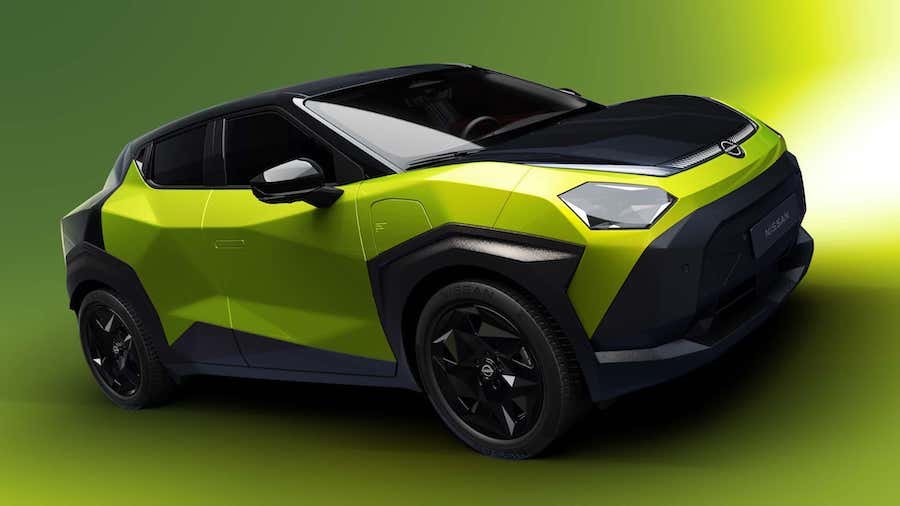
The Nissan Juke has never been about fitting in among other subcompact crossovers. It had a striking design from day one, and while that was a risky bet, it ultimately paid off. In Europe alone, Nissan has sold 1.5 million units since the original debuted in 2010, replaced nine years later by an equally polarizing second generation. Fast forward to 2026, and the third-gen model is here, looking even more eccentric.
The all-new Juke is chock-full of edges and stands out in a segment dominated by curvy, often bulbous crossovers. We reckon Nissan must have used a razor during the design process, as the body is all about sharp angles. Even one of the wheel designs gives off a strong concept vibe, ditching conventional spokes in favor of a pixelated pattern.
As with the two preceding generations, the rear door handles are “hidden” in the pillars to create the illusion of a two-door coupe. Overall, you’d have a hard time guessing this bold new origami-like Juke is closely related to the more conventional-looking Leaf, as the two share the same CMF-EV platform. Yes, the next Juke will be electric, and electric only.
However, Nissan won’t be saying goodbye to the second generation just yet. The current hybrid will soldier on, which seems like a smart move, as going EV-only would be premature. Both versions will be built at the Sunderland plant in the UK, with the third generation scheduled to launch in Europe next spring.
For now, Nissan is only showing the exterior design. We’ll have to wait a bit longer to see the interior and learn about the technical specifications. Considering the new Juke is closely tied to the Leaf, it’s worth noting that the latter is sold in Europe with two battery packs: 52 kWh and 75 kWh. It offers a WLTP range of 271 miles (436 kilometers) with the standard battery and up to 375 miles (604 kilometers) with the larger pack.
If it follows the Leaf’s formula, the new Juke will likely be front-wheel drive, with a single motor powering the front wheels. The base Leaf produces 174 hp and 255 lb-ft (345 Nm), while the more potent version delivers 215 hp and 262 lb-ft (355 Nm). The latter needs 7.6 seconds to reach 62 mph (100 km/h).
