Hyundai's Smallest SUV In Europe Gets A Major Glow-Up For 2027
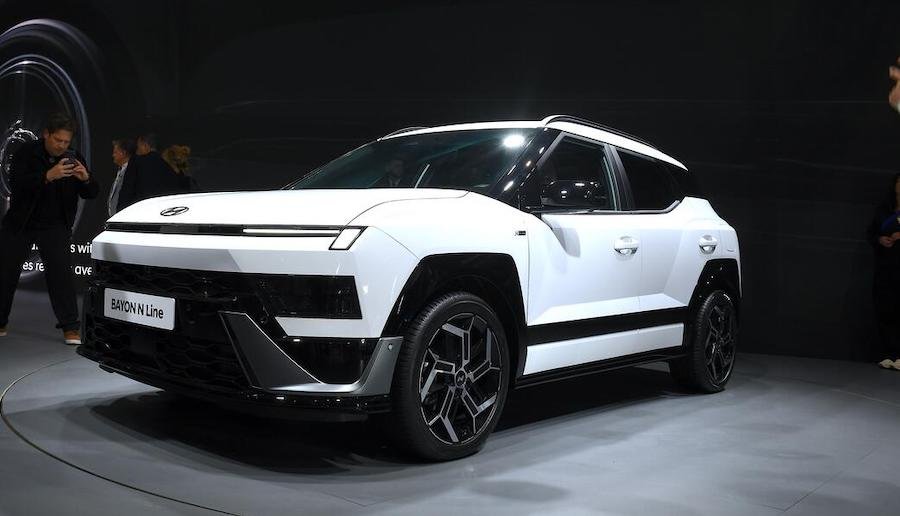
Like everywhere else, Europeans have an insatiable thirst for crossovers. That's why Hyundai feels confident giving the Bayon a second generation, even though the Kona was once the brand’s entry-level SUV. The new model is growing in almost every direction and gaining a more angular design.
Looking as if a Kona and a next-gen Elantra spent the night together, the new Bayon features sharper creases, pronounced fenders, chunky body cladding, and a more upright stance. A full-width horizontal lighting signature dominates the front end, while projection LED headlights with static bending lights provide additional illumination. The rear echoes the front lighting treatment, and an angular skid plate reinforces the crossover’s rugged appearance.
Hyundai is keeping the Bayon compact enough for urban driving, but the new model is noticeably larger than its predecessor. At 4,245 millimeters (167.1 inches) long and 1,810 mm (71.3 in) wide, it gains 65 mm (2.6 in) in length and 35 mm (1.4 in) in width. The wheelbase measures 2,600 mm (102.4 in), while ground clearance varies by powertrain and wheel size.
The New Hyundai Bayon Gets The N Line Treatment
Buyers can choose alloy wheels up to 18 inches, a two-tone roof, and solid, metallic, pearl, or matte exterior finishes. Available from day one, the sportier N Line stands out with dedicated 18-inch wheels, technical mesh details, high-gloss black cladding, and a rear diffuser incorporating twin exhaust outlets. Inside, the range-topping trim gets cloth and suede seats with red accents.
Practicality remains a priority. Internal-combustion versions offer 440 liters (15.5 cubic feet) of luggage capacity, with additional storage beneath the cargo floor. Predictably, the hybrid has a smaller 397-liter (14.0 cu. ft.) trunk to accommodate the battery and other hybrid hardware.
Major Tech Upgrade, But With Plenty Of Buttons
The cabin receives a substantial technology upgrade. Depending on the spec, the dashboard combines a 12.3-inch infotainment screen with an equally sized digital instrument cluster in a curved, panoramic layout. The center console looks a bit unorthodox, but it offers plenty of buttons, flanked by unusually long vertical air vents.
Even though it sits at the bottom of the barrel among Hyundai’s crossovers, the Bayon has all the tech you could want. There’s wireless Apple CarPlay and Android Auto, wireless phone charging, and the option to use a smartphone or smartwatch as a digital key. Other goodies include heated and ventilated front seats, heated rear seats, reclining rear seatbacks, dedicated rear air vents, a Bose sound system, and even an opening panoramic sunroof.
The 2027 Hyundai Bayon Gets Gas And Hybrid Power
At launch, the new Bayon will offer a turbocharged 1.0-liter gasoline engine producing either 90 or 115 horsepower. It offers a six-speed manual transmission (yes, it’s still available) or a seven-speed dual-clutch automatic, depending on the version. The more powerful model reaches 112 mph (180 km/h), while the entry-level version tops out at 106 mph (171 km/h).
But the bigger news is the addition of a full-hybrid setup, upgrading from the previous-generation model’s mild-hybrid system. It’s coming later, pairing a 1.6-liter gasoline engine with an electric motor and a six-speed dual-clutch transmission. The system produces a combined 136 hp and includes adaptive regenerative braking, with steering-wheel paddles letting drivers adjust the energy recuperation level.
The new Bayon arrives as small crossovers are increasingly expected to offer the technology and comfort of much larger vehicles without sacrificing their city-friendly dimensions. Hyundai’s latest offering seems determined to meet those expectations, though it has yet to announce pricing or market-specific availability details.
2027 Hyundai Bayon
For now, the formula is straightforward: a chunkier, Robocop-like design; a more sophisticated cabin; a generous list of driver-assistance systems; and, most importantly, a hybrid option coming later.
With Hyundai giving the Bayon a glow-up, we’re now wondering whether it’ll cannibalize Kona sales. Then again, that might be a good problem to have. For customers, more variety is always welcome, although some might feel overwhelmed by the sheer number of small crossovers on the market.
