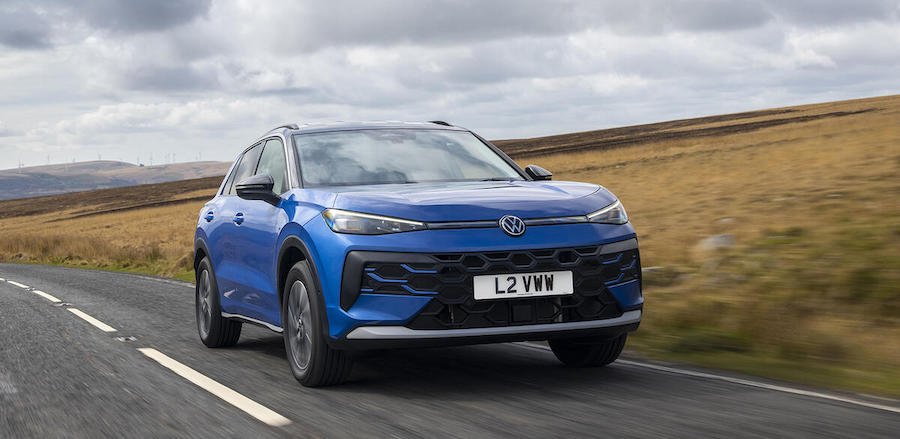
You may already have read Illya Verpraet’s comprehensive report on the new Volkswagen T-Roc, dispatched from Lisbon in November.
And in just a couple of months' time you’ll be able to read an even more comprehensive review, bolstered by economy and performance figures obtained at Horiba MIRA proving ground, when the T-Roc undergoes its full road test.
But in case this is somehow not enough T-Roc for you, here’s a brief report from the car’s fresh-off-the-boat arrival into the UK – a market in which the first-generation model was spectacularly successful between 2017 and 2025, even as its specific niche became increasingly crowded. In 2026 its chief rivals are the Toyota C-HR, Renault Symbioz and Skoda Karoq, and the latest Nissan Qashqai is another serious alternative.
These drives on UK Tarmac matter more for some cars than others, and the Golf-on-stilts T-Roc is one of those for which our crumbling roads might be its undoing. For one thing, VW will sell plenty of these in top-billing R-Line trim, shod with 19in flying-saucer wheels and slithers of rubber for sidewalls.
Found beneath other models in the VW stable, the T-Roc’s MQB Evo platform has also been hit-and-miss in terms of ride quality, but it's a complex picture, because the dampers you opt for have a significant bearing on the car’s ability to weather cruddy surfaces. Even with the T-Roc, a comparatively junior member of an SUV family that culminates in the Touareg, you can choose between ordinary passive dampers and adjustable dampers with selectable rates (for £765). Ride quality is likely to be rather dependent on specification, then. More on that in a moment.
As for the engine line-up, for now there is only VW’s excellent 1.5-litre eTSI mild-hybrid petrol four, albeit available in two tunes: 114bhp or 148bhp. If you can wait until later in the year, the T-Roc will gain a full-hybrid powertrain with 134bhp or 168bhp, which ought to push economy well beyond the declared figure of 50mpg for the 1.5 eTSI.
Of course, a hybrid T-Roc will also be a more expensive T-Roc. Currently the range starts at £31,635 for base Life trim with the 114bhp engine and extends to more than £40,000 if you opt for R-Line trim with the 148bhp engine and some optional extras, such as the £2260 Leather Comfort Pack and £465 matrix headlights (all very grown-up).
I won’t dwell on the cabin here, but in a nutshell the comfort of the seats (particularly in R-Line cars) and the general feeling of quality are improved versus the original T-Roc, and they certainly sit at the sharp end of the class. The fact that the new car has had 30mm injected into the wheelbase has done no harm to rear leg room either, and a longer rear overhang takes boot capacity to 475 litres, up from 445 litres. The T-Roc still can’t match the Karoq (521 litres), but it comfortably outhauls the Golf.
Drivability is generally good, the 1.5 eTSI pulling you along with decent smoothness and enthusiasm from 2000rpm and pairing neatly with the seven-speed dual-clutch automatic gearbox. Having tried the 148bhp variant, I possibly wouldn’t entertain the thought of having the 114bhp version unless the cost difference (reasonable at just over £2000) were going to be a deal-breaker.
Economy is good too: my car returned 46.4mpg on a representative mixed-driving route. That’s 500 miles on a tank.
The T-Roc also steers and stops with the intuitive maturity you’d generally expect of a Volkswagen.
It’s all appealing enough, but ride quality is indeed the possible weak spot. My test car rode on passive dampers and the smallest 17in wheels, with a general set-up that clearly tends towards the sportier end of what’s acceptable for a basic T-Roc (stand by for a possible R derivative). Body control is fine and the car corners cohesively.
It isn’t difficult to imagine being impressed with the package on smoother European roads, and the T-Roc is assured on the motorway. But that decision to tie the body a little more closely to the chassis has repercussions here in the UK, and one of them is that, on country roads and smaller A-roads, the T-Roc will crash over pockmarked surfaces and the like. Unfortunately there is currently enough of that sort of thing in the country to make this a notable drawback.
Interestingly, a car with the same dampers but the larger, 18in wheels fared no worse.
Your best bet is probably to spec an R-Line car with the adaptive dampers and the 18in wheels. Very few people will do this: it’s expensive and people generally don’t buy an R-Line VW to have smaller wheels. But if it rounded off the ride, the result would be an even better little crossover.
Volkswagen T-Roc Life 1.5 eTSI 150PS
Price £32,335 Engine 4 cyls in line, 1498cc, turbocharged, petrol, plus 48V ISG Power 148bhp at 5000-6000rpm Torque 184lb ft at 1500-3000rpm Gearbox 7-spd dual-clutch auto, FWD Kerb weight (DIN) 1399kg 0-62mph 8.9sec Top speed 132mph Economy 50.3mpg CO2, BIK tax 128g/km, 31%
