Relive The Mitsubishi Glory Days With This 1985 Pajero Restoration
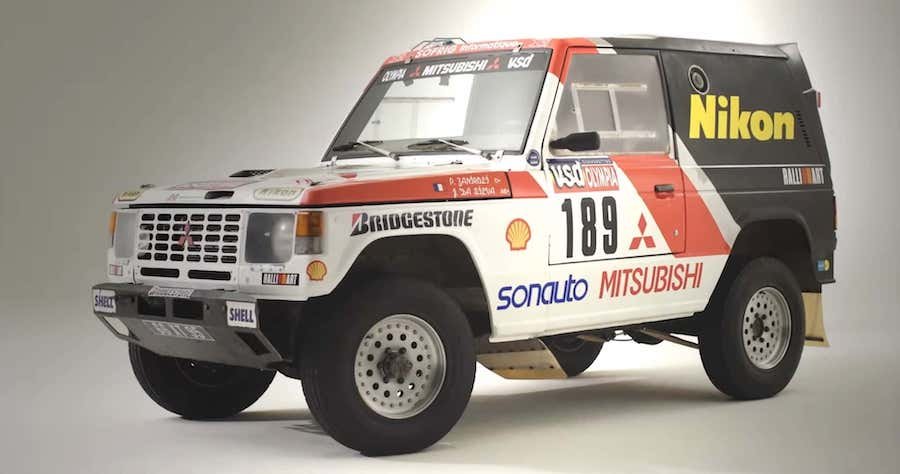
In fact, exactly 40 years ago, those two ideologies converged on the 1985 Pajero prototype, which took the overall win at that year's Paris-Dakar Rally and established a dynasty that would see 12 total victories for the Pajero/Montero family, including seven consecutive years from 2001 to 2007.
To recognize its first victor's achievement, Mitsubishi recently dusted off that 1985 Pajero and treated it to a sympathetic restoration, and now, it's back on the road (or dirt, as it were).
A Real Technological Achievement
Prior to its 1985 victory, Mitsubishi had competed twice in the Dakar Rally, with 1983 and 1984 bringing victories in the non-modified production car class. But for 1985, the company set its sights on an overall victory in the prototype class. Although the 1985 competitor looks outwardly similar to the showroom-ready Pajero and Montero, its bodywork hides a sophisticated tube-style chassis, and stripped down to just the necessessities, the completed ute weighed a mere 2,645 pounds.
Propelling it through the desert was a decidedly non-stock turbocharged 2.6-liter inline-four with 222 horsepower and 231 pound-feet of torque, with a five-speed manual transmission. Despite its tall stance and off-road tires, the Pajero prototype could hit 115 miles per hour, according to Mitsubishi, helping it traverse the special-stage rally in a total of just 48 hours and 27 minutes – an average pace of 96 miles per hour.
Reviving Mitsu's Original Dakar Winner
Following its achievement in the African desert, the 1985 Pajero prototype was sent back to Japan, where it spent the last four decades as a semi-permanent fixture in Mitsubishi's R&D department. The time and inactivity had taken a toll on the racer, but the automaker decided to revive it in celebration of its 1985 victory. A team of original works engineers for the World Rally Championship and Dakar Rally led the project, with current Mitsu engineers assisting and learning about how things used to be done at the company.
The Pajero prototype was stripped and almost entirely disassembled, with each component inspected for damage and deterioration, including that highly strung 4G54 turbocharged engine. According to the company, however, none of the motor's major parts needed replacement, meaning that the four-cylinder under the hood is largely the same one that raced from Paris to Alger and from Alger to Dakar.
View this post on Instagram
The same can be said of the prototype's body panels, which were mostly left in as-found condition. The works team did a few paint and body repairs, but there's still plenty of race wear visible in the bodywork, with scratches and dents that reflect the robust, 6,390-mile total trip – of which 4,652 were timed, special-stage competition miles. The finished product is a triumph of sympathetic preservation, repairing any damage that might lead to further decay while leaving the truck's character intact.
The 1985 winner isn't the only restored Pajero/Montero in the company's fleet. Mitsubishi showed its newest (oldest?) baby off alongside the overall winners of the 1998, 2002, and 2007 rallies, as well as the first 1983 Pajero competitor that won its non-modified production class and finished 11th in total.
