Toyota's New Hilux Pickup Goes Diesel, Electric, And Hydrogen All In One
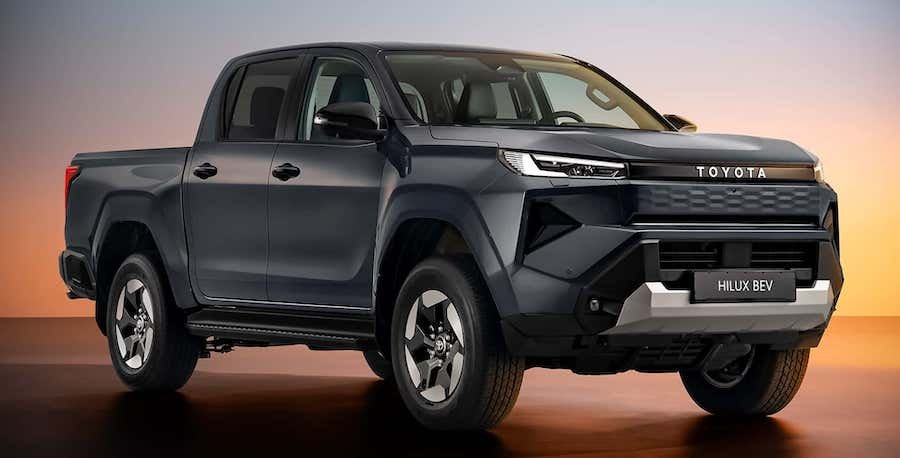
The latest – representing the ninth generation for the nameplate – was unveiled overnight in Thailand, where much of the development took place. Thailand is also one of six countries where Hilux production is handled, both for local sale and export.
The new Hilux is more of a major update of the previous generation, as opposed to a ground-up redesign like the latest Toyota Tacoma sold in the US. The big news is the availability of more powertrain options, including, for the first time, electric and even hydrogen fuel cell powertrains.
Underpinning the new Hilux is the latest evolution of Toyota's IMV (Innovative International Multi-purpose Vehicle) platform that debuted two decades ago in the seventh-generation Hilux. It's a body-on-frame design much like the TNGA-F platform that underpins Toyota's trucks sold in the U.S., including the Tacoma midsize pickup. However, it is a simpler and tougher design, still utilizing leaf springs in the rear instead of the more comfort-oriented multilink setups found in TNGA-F trucks. It's also a lot less modular.
Key updates to the latest version of the IMV platform include a new electric power steering system, redesigned engine and cabin mounts to reduce vibration, extended front frame rails for improved crash performance, and a revised suspension setup featuring independent coil-spring suspension at the front and a rigid rear axle with leaf springs. Also new is a standard rear locking differential for four-wheel-drive versions, along with the option of Toyota's Multi-Terrain Select system.
The interior design has also been upgraded, with grades that often double as family haulers getting more tech and comfort features. The list includes a 12.3-inch digital instrument cluster (seven inches in lower grades) and a 12.3-inch infotainment screen. There are also plenty of physical buttons, including on the steering wheel, which is borrowed from the Land Cruiser. Toyota has also added more electronic driver-assist features, support for over-the-air updates, and a wireless phone charger.
Diverse Powertrains For Diverse Markets
Since the Hilux is a true global pickup, Toyota has made efforts to increase the flexibility of the latest model. Conventional powertrains like gas and diesel engines will still be offered, and in some markets, there will also be 48-volt mild-hybrid, electric, and fuel cell options. It's all part of Toyota's successful multi-path approach to reducing emissions, which essentially tailors the powertrain lineup to meet the energy needs of various regions. A conventional hybrid system wasn't mentioned, though.
Toyota only provided specifics on the electric powertrain, which features a 59.2-kilowatt-hour lithium-ion battery and a dual-motor all-wheel-drive system delivering a total of 193 horsepower. Toyota's estimated range on a charge is about 150 miles, based on the WLTP test cycle used overseas. A lower estimate would result using the stricter EPA test cycle. Other estimates include payload and towing capacities of 1,575 pounds and 3,527 pounds, respectively.
The 48-volt mild-hybrid powertrain will use a diesel engine – a 2.8-liter turbodiesel inline-four. The powertrain is actually a carryover unit from the one introduced to the current Hilux range in 2025, which generates 201 horsepower and 369 pound-feet of torque from the diesel engine alone. The mild-hybrid system adds a temporary boost of 16 hp and 48 lb-ft of torque during high-load situations. Payload and towing capacities for the former model are 2,200 pounds and 7,700 pounds, respectively. Expect similar numbers for the new generation.
Toyota plans to start deliveries of the new Hilux in the first half of 2026. The fuel cell model, which will be aimed at Europe and several Pacific countries, will only be available from 2028.
